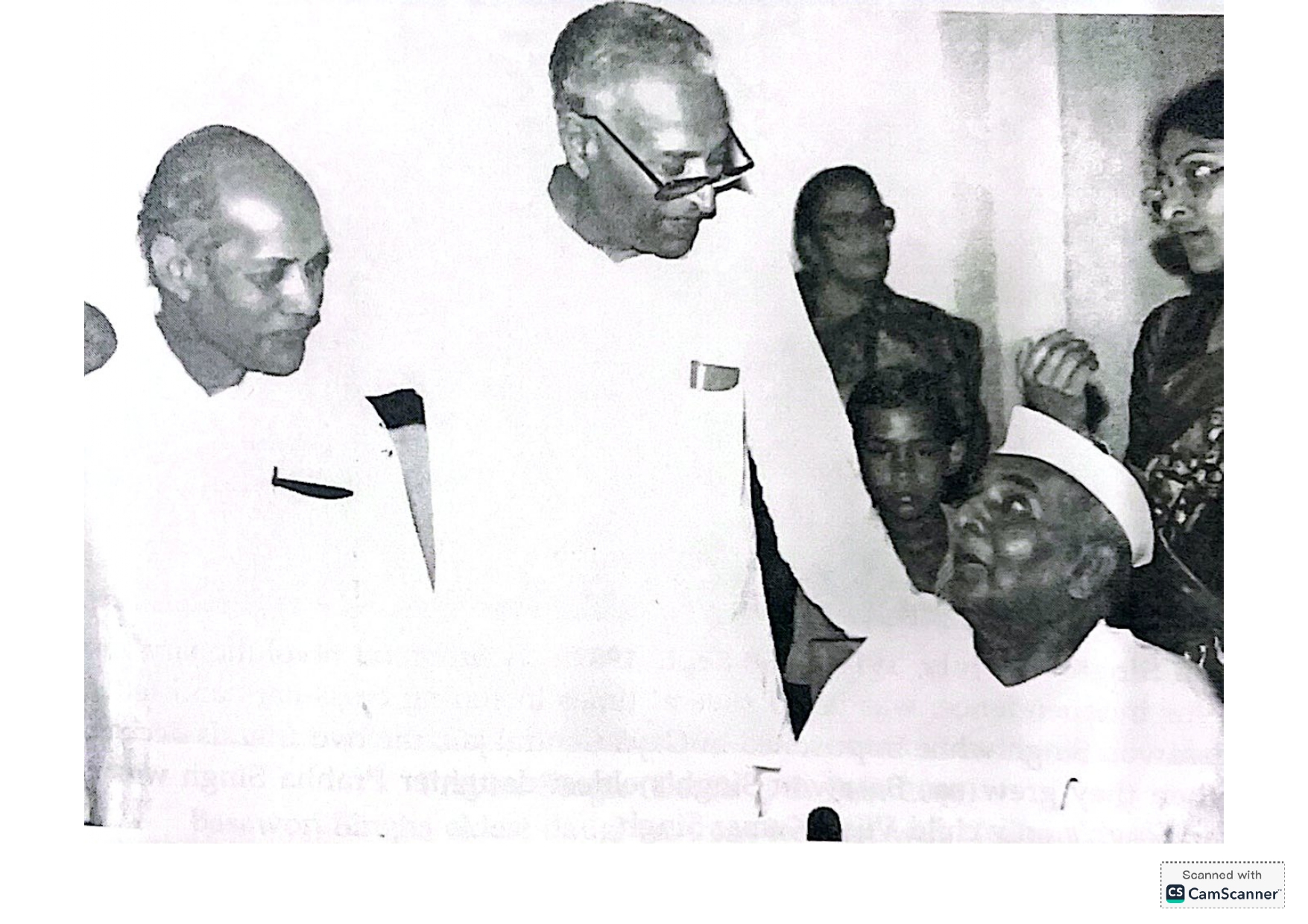
Dr. Ganga Sharan Singh – An eminent scholar, leader and contributor to knowledge building
Akansha Rai
‘Asar lubhane ka pyaare tere byaan mein tha, Kisi ki aankh mein jaadu, teri zubaan mein tha.’
Born on August 14, 1905 in a small village- Kanchanpur (Bihta, Patna, Bengal Presidency), Dr. Ganga Sharan Singh (Sinha) fondly called (‘Ganga Babu’) is a notable figure in India’s literary, social and political landscape. Mastered in communication, he is known to be a treasure house of wit and humour. Those who met him often remarked his personality as an inexhaustible reservoir of simplicity and dignity. Shankar Dayal Singh, a prolific author and popular columnist has aptly written about him: “On seeing him, one is reminded of Chanakya’s words—‘In the world there are neither friends nor enemies; it is circumstances that turn people into friends or enemies.’…. It feels as if Chanakya himself had envisaged him while saying this, and he firmly believed that even two thousand years later, the world would witness such a person.”
Dr. Singh hailed from a modest zamindar family. His father, Ram Prasad Singh (also known as ‘Dashrath’ and his mother Kamleshwari provided him a stable familial foundation. As the first child of his parents (being lovingly called Badka babu), with two younger brothers- Sarveshwari Sharan (Chhote Babu) and Shashi Shekhar Sharan (Lallu Babu), Ganga Babu epitomised the role of a loving, caring and dutiful elder brother. His family members loved and respected him deeply. Principally, his conception of family extended far beyond blood relations. He regarded the entire nation as his own family, mingling effortlessly with everyone from all walks of life.
He was married to Chandramani, daughter of Ragho Prasad Singh, a resident of Malhad village in Gaya district. His wife was a woman of remarkable resilience, generosity, simplicity and played a significant role in developing Ganga Babu’s personality. Notably, for her husband’s advancement she donated her jewellery to support the establishment of a printing press. Ganga babu, too, never fell short in demonstrating his greatness. Despite his personal loss of losing his wife untimely, he resolved never to remarry for the sake of a son. His legacy is followed by his only daughter, Manju.
Throughout his life, Ganga Babu endured persistent ill health. He suffered from asthma, tuberculosis, heart disease, prostate enlargement, liver ailments and gall bladder stones. He also had a ‘pacemaker’ installed to regulate his heart condition. However, with his strong spirit, his intellectual vitality and social engagement kept growing. His association with national leaders and movements was formative. He was very close to both- Dr. Rajendra Prasad and Jayaprakash Narayan with whom he spent a long period of his life. From 1921 to 1931, he stayed at Sadaquat Ashram with Dr. Rajendra Prasad and then from 1937 to 1954-55, he stayed with Jayaprakash Narayan.
He remained emotionally affected by passing of his family members including Chotte Babu and Lallu Babu along with his great contemporaries such as Shyam Nandan Babu, Benipuri, Dinkar, Jayaprakash Narayan, Prabhavati, and many others. He didn’t view the death of his distinguished fellows just as his personal loss but as civilisational ruptures. While he bore such losses with philosophical composure, the loss of his family members, particularly of his niece Acchla, moved him deeply, revealing his tender emotional core.
Ganga Babu’s primary education began in his maternal village Ghataro. He moved to his village Kanchanpur at the age of 10 and joined Middle English School, Fatuha. The headmaster of the school, Pandit Ramchandra Dwivedi, was a close friend of Ram Prasad Singh ji, who left a huge influence on Ganga Babu. From Fatuha, he shifted to Lai with Dwivedi ji where he got introduced to Bihar’s first distinguished literary figure- Ramvriksha Rai Sharma (author of Sadachaar Sopan) and was drawn towards him. His formal studies got disrupted by the Non-Coorperation Movement of 1921 when his interest in politics permanently eclipsed conventional academics. Later, in 1927 he formalised his qualification with Sahitya Ratna degree with Akhil Bhartiya Hindi Sahitya Sammelan, Prayag while remaining a lifelong learner under the mentorship of Ram Kripal Singh Guru, Pandit Ramchandra Dwivedi, Ramvriksha Rai Sharma, Pandit Yugal Kishore, Dev Nandan Singh and others. His exposure to nationalist newspapers, journals, and revolutionary literature awakened a deep patriotic consciousness within him.
His interests were diverse. Physically active and culturally curious, Ganga Babu enjoyed wrestling, kabbadi, mountain travel, folk traditions and books. He travelled extensively across India- from Assam to Kashmir, from plains to the Himalayas undertaking multiple pilgrimages to Badrinath and
Kedarnath. Apart from his travel diaries, his literary tastes were vast and multilingual. Among classical and modern Hindi poets he was deeply influenced by Bihari, Dwivedi, Tulsidas, Pratap Shahi, Maithilisharan Gupta, Dinkar, Nirala and Mahadevi; from Bengali writers such as Sharatchandra, Tagore, Tarashankar Banerjee and Nazrul Islam; and from Urdu poets such as Ghalib, Mir, Faiz and Nizami. In Sanskrit literature, he followed masters like Kalidasa, Bhanbhatta, Bhavbhuti and Shriharsh and among English writers were Shakespeare, Shelly and Keats. His social and literary network was immense- encompassing leading figures of Hindi literature, regional writers from Bihar, non-Hindi intellectuals, social workers and political leaders, he maintained an abundance of relationships.
Ganga Babu is renowned for his extraordinary memory and has earned the title for an ‘encyclopaedia of ancient Hindi poets.’ He had memorised innumerable passages in Sanskrit, Hindi, Urdu–Persian, Bangla, and English. His writings, though largely unpublished demonstrates a sharp satirical intellect. Works such as Vichar-Pravah, Padya-Pravah, Sahitya-Vimarsh and Sahitya- Pravah exposes his literary prowess and power dynamics with wit and irony. His interest in politics consumed much of his creative time and energy- a loss lamented by Maithilisharan Gupta who believed Ganga Babu could have been a great poet if not inclined towards public life. Yet, his prose remains remarkable for its philosophical depth, linguistic clarity and cultural inclusiveness. His vision of Indian languages as diverse expressions of a shared civilisational spirit is a rare synthesis of moral courage, intellectual breadth, human compassion and cultural nationalism. Additionally, Dr. Singh’s public life also demonstrates the extent of his contribution in literary creativity, institutional leadership, political commitment and lifelong service to the cause of enhancing Bihar’s literary prestige.
His literary activity continued upto around 1930 during which he worked in multiple literary roles- as editor, critic, poet, short-story writer, essayist, and reviewer—and also contributed regularly to leading Hindi journals and magazines such as Madhuri, Samalochak, Kavi, Matwala, Hindu Punch, Balak, Desh, Samellan Patrika (Prayag), Dharmayug, Aaj, and Hindustan. He also played an important role in editing of the book ‘Hindi Sahitya aur Bihar’, published by the Bihar Rashtrabhasha Parishad. Acharya Shivpujan Sahay records that Ganga Sharan Singh personally travelled extensively across Bihar to collect material for this work. His collaboration with Benipuri, Raghunandan Prasad Singh, Mathura Prasad Dixit and others resulted in a comprehensive and
authoritative documentation of Bihar’s Hindi literary heritage. His works reached a wide readership and helped shape the tone of Hindi literary discourse in the early twentieth century.
Dr. Singh’s engagement with language policy further reflects his intellectual seriousness. In early 1935, the Education Department of the Bihar Government issued a circular deciding that beyond the lower primary level, the regional language should be dropped and other subjects should be taught in “common language.” To deliberate upon this decision, a sub-committee was constituted during the special session of the Bihar Hindi Sahitya Sammelan. As a respected member of this committee, Dr. Singh supported the idea of a common language in principle but strongly opposed the government’s method. The committee concluded that imposing a common language through administrative orders would neither create linguistic unity nor yield educational benefits, and recommended abandoning the policy. This intervention demonstrated his nuanced understanding of language planning, rooted in cultural realism rather than bureaucratic imposition. Apart from such scholarship and leadership, it is said that from 1923-1926 he worked (often at his own expense) to identify and encourage Hindi writers and poets from Bihar. He worked tirelessly in promoting the practical use of Hindi. He played a vital role in establishing national-level institutions such as the Akhil Bharatiya Hindi Sanstha Sangh (New Delhi) and the Akhil Bharatiya Sahityakar Pratishthan. He was also instrumental in establishing the Rashtrabhasha Prachar Samiti, an organisation that aimed to secure a rightful place for Hindi and other Indian languages in central administration.
His devotion to Hindi was deeply personal as well as institutional. He is known to be a unique combination of Bharatendu’s spirit of literary service, Padma Singh Sharma’s prodigious memory, and Rahul Sankrityayan’s passion for research. As an institutional leader, his influence was extraordinary. While serving as president or vice-president at numerous educational, cultural, and social bodies across India, his leadership helped expand Hindi far beyond North India, gaining remarkable acceptance in the South as well where his popularity in literary, cultural and political forums was unmatched.
His journalistic career was equally notable. He served as editorial board member of Yuvak (Patna, 1928), Janata (Patna, 1936), Janvaani (Kashi, 1946–47), and the English weekly Everyman (Delhi, 1974). He held a reputed position as a member of Board of directors at National Herald until his death. Writing under the pen name ‘Vishvavihari’ , his popularity and influence was so strong that
the government authorities instructed academic institutions to prevent certain professors from contributing to the same magazine.
Dr. Singh’s was associated with an extraordinary range of institutions where he held high positions as president, vice-president, chairman, editorial or board member. Few of these includes- Akhil Bharatiya Hindi Sanstha Sangh (New Delhi), National Association for Pre-School Children (New Delhi), Acharya Narendra Dev Socialist Institution (Varanasi), Balika Vidyapeeth (Lakhisarai, Bihar), Curriculum and Selection Committee for Hindi Examinations Conducted Abroad (New Delhi) Acharya Narendra Dev Socialist Institution (Varanasi), South East Asian Studies Centre (Gaya), Executive Chairman of Samachar Bharati, President of the Prisoners’ Organization at Phulwari Camp Jail (Bihar from 1930–1932), Hindi Vidyapeeth (Deoghar, Bihar), Kendriya Hindi Samiti (Delhi), Kendriya Sanskrit Parishad (Delhi), Bihar Rashtrabhasha Parishad (Patna), Hindi Advisory Committee of the Ministry of Law and Justice, Bharatiya Bhasha Parishad and many more. His membership at such diverse institutions demonstrates his inclusive linguistic vision and national stature.
Politically, Dr. Singh was a frontline leader of the freedom movement and the socialist tradition. During the movements of 1930 and 1932, he was arrested and sent to jail. He also took key positions and discharged many political and social responsibilities. Few of them include a Congress leader in Bihar during the movements of 1930 and 1932, secretary of the Bihar Congress Parliamentary Board from 1936, secretary of the Bihar Socialist Party from 1931, Minister of the Bihar Kisan Sabha, President of the Praja Socialist Party from 1956 to 1969, and as its leader in the Rajya Sabha from 1956 onwards. His political life was marked by integrity, ideological commitment and sustained public service.
With his contributions, it is evident that Ganga Babu was not merely a litterateur and a successful promoter of the national language Hindi but also a knowledgeable scholar of philosophy, sociology, religious studies, and political science. In recognition of his immense contributions, he received numerous honours including multiple honorary D.Litt. degrees (from Agra University in 1974 and Patna University in 1984), titles such as Rashtrabhasha Setu, Sahitya Vachaspati, Chudamani, and Bihar Ratna (1986), and prestigious awards from national and state institutions. From 1956 to 1974, he served as an honoured member of the Rajya Sabha, and ultimately completed a full and dignified public life devoted to national service.
Ganga Babu passed away on August 19, 1988 at the age of 83. His death marked the end of an era, but his legacy and influence will never fade. Future generations, through institutions and awards continue to draw inspiration from him. His life stands as a testament to the power of language, ideas and selfless national service.