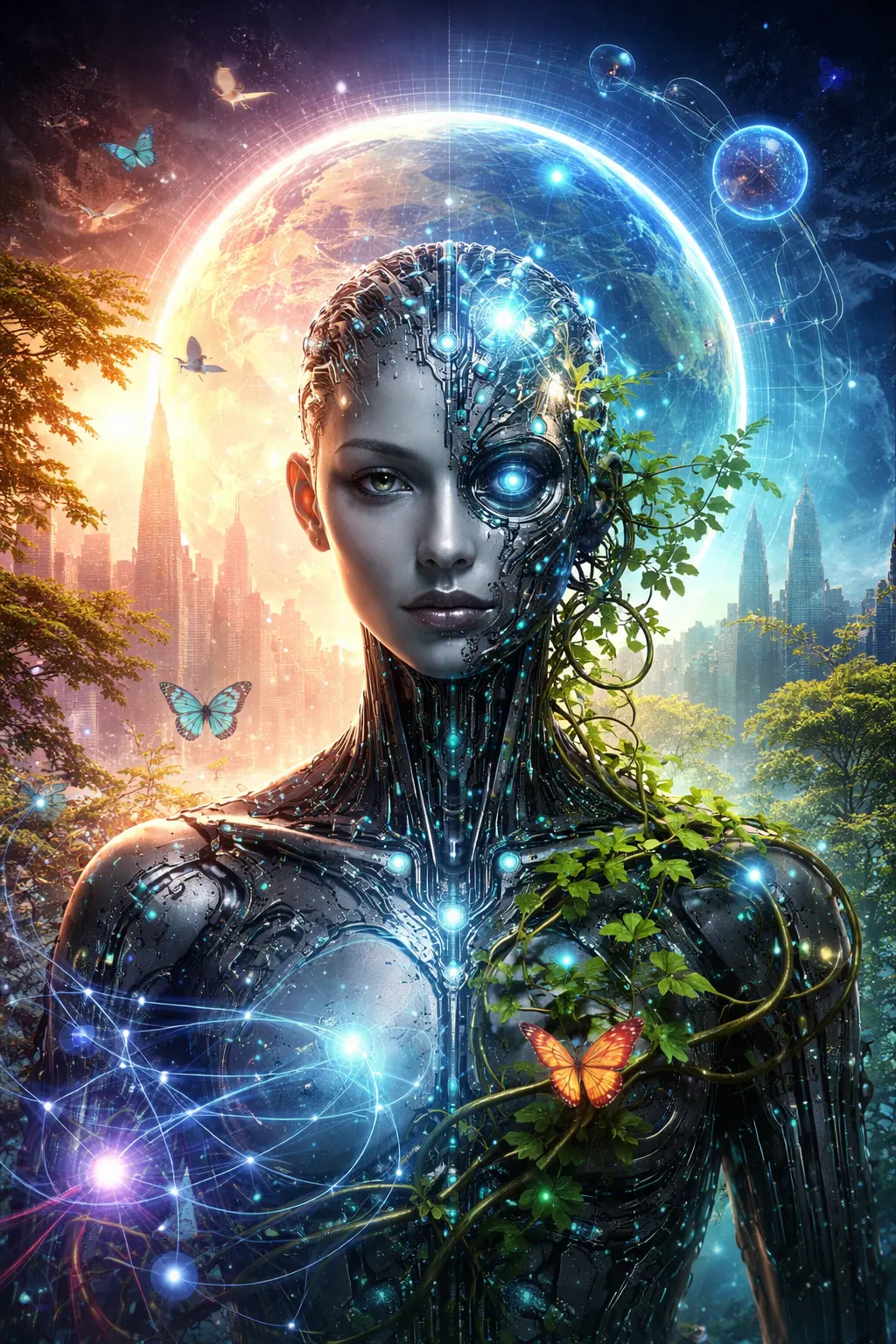
Posthumanism: Rethinking the Human in Philosophy, Technology, and Literature
Anil K Prasad, Ph.D
Introduction
The concept of the posthuman has emerged as one of the most significant intellectual developments in late twentieth- and early twenty-first-century thought. It challenges the centrality of the human as an autonomous, rational being—an assumption rooted in Renaissance and Enlightenment humanism. Instead, posthumanism redefines human identity in terms of networks, hybridity, and interdependence with technology, animals, and the environment. In the age of artificial intelligence, biotechnology, and climate change, posthumanism provides a critical framework for rethinking what it means to be human.
1. Philosophical Foundations of the Posthuman
Posthumanism builds on poststructuralist and postmodernist critiques of stable identity and universal reason.
Donna Haraway’s “A Cyborg Manifesto” (1985) uses the metaphor of the cyborg to illustrate hybrid beings that transcend dualisms—human/machine, male/female, nature/culture. Haraway argues that embracing hybridity disrupts humanist boundaries.
Cary Wolfe in What is Posthumanism? (2010) calls for a move beyond anthropocentrism and critiques human exceptionalism, emphasizing that humans are embedded within ecological and technological systems.
Rosi Braidotti, in The Posthuman (2013), sees the posthuman condition as a necessary response to globalization, ecological crises, and technological transformation.
Thus, the posthuman is not only about futuristic technology but also a philosophical critique of how the category “human” has historically been defined.
2. Technological Dimensions: From Human to Posthuman
In transhumanist thought, the posthuman is often imagined as an evolved being enhanced by technology:
Cybernetics and AI: The possibility of “mind uploading,” human-machine integration, and autonomous AI raises questions about identity and consciousness.
Biotechnology: Genetic engineering and cloning blur the line between human and artificial life.
Cyborgs: Artificial limbs, neural implants, and wearable tech create hybrid bodies, complicating the distinction between human and machine.
Ray Kurzweil’s idea of the “Singularity”—a future point where humans and AI merge—represents a technological utopia of posthumanism. However, critical theorists warn against seeing technology as salvation and instead urge reflection on its ethical and cultural consequences.
3. Cultural and Literary Explorations of the Posthuman
Literature has long served as a laboratory for imagining posthuman futures:
Mary Shelley’s Frankenstein (1818) can be seen as a proto-posthuman text, where human ambition to create life leads to a hybrid being outside conventional categories.
Margaret Atwood’s Oryx and Crake (2003) present genetically modified humans and bio-engineered species, questioning the ethics of scientific experimentation.
Octavia Butler’s Xenogenesis trilogy (1987–89) imagines alien-human hybrids, raising questions about identity, survival, and inter-species dependence.
William Gibson’s cyberpunk novel Neuromancer (1984) explores virtualconsciousness and the fusion of human and machine.
In the South Asian context, writers are beginning to explore posthuman themes:
Amitav Ghosh’s The Calcutta Chromosome (1995) blends genetics, disease, and technology with mysticism, foreshadowing debates on biotechnology and identity.
Vandana Singh’s science fiction stories (The Woman Who Thought She Was a planet, 2008) use speculative narratives to interrogate science, technology, and ecology from an Indian perspective.
4. Ethical and Ecological Dimensions
Posthumanism is not only about technology but also about rethinking human responsibility:
Climate change and ecological crisis show that human survival is deeply connected with non-human species and planetary systems.
Animal rights and environmental ethics are strengthened by posthumanist thought, as it emphasizes interdependence rather than domination.
In this sense, the posthuman opens space for more inclusive, relational ethics—moving from “man as the measure of all things” to a shared planetary existence.
5. Significance for Research and Education
For research scholars, posthumanism provides:
A critical framework to analyse how literature, film, and digital culture imagine changing human identity.
A way to connect philosophy, science, and literature, bridging disciplinary boundaries.
Insight into how global South perspectives (South Asia, Africa, Latin America) can enrich posthuman debates, often dominated by Euro-American contexts.
The inclusion of posthuman themes in university curricula—through literary texts, critical theory, and cultural studies—would encourage students to engage with pressing issues of technology, ecology, and ethics.
Conclusion
The posthuman is not the “end” of the human but a call to rethink what it means to be human in a rapidly changing world. It resists anthropocentrism, challenges humanist binaries, and urges a relational understanding of life. In philosophy, technology, and literature alike, the posthuman reminds us that humanity is not isolated but interwoven
with machines, animals, environments, and other forms of life.
As Rosi Braidotti observes, “Posthumanism is both a critique of the universal humanist subject and a reconfiguration of human subjectivity in relation to the non- human.” For scholars and students alike, this is an invitation to imagine futures beyond the boundaries of human exceptionalism.
Anil Kumar Prasad, a creative thinker and former professor of English, is now actively working as a human rights and social activist.